
The Annual Cost of Owning a Yacht in Australia: 2026 Comprehensive Guide
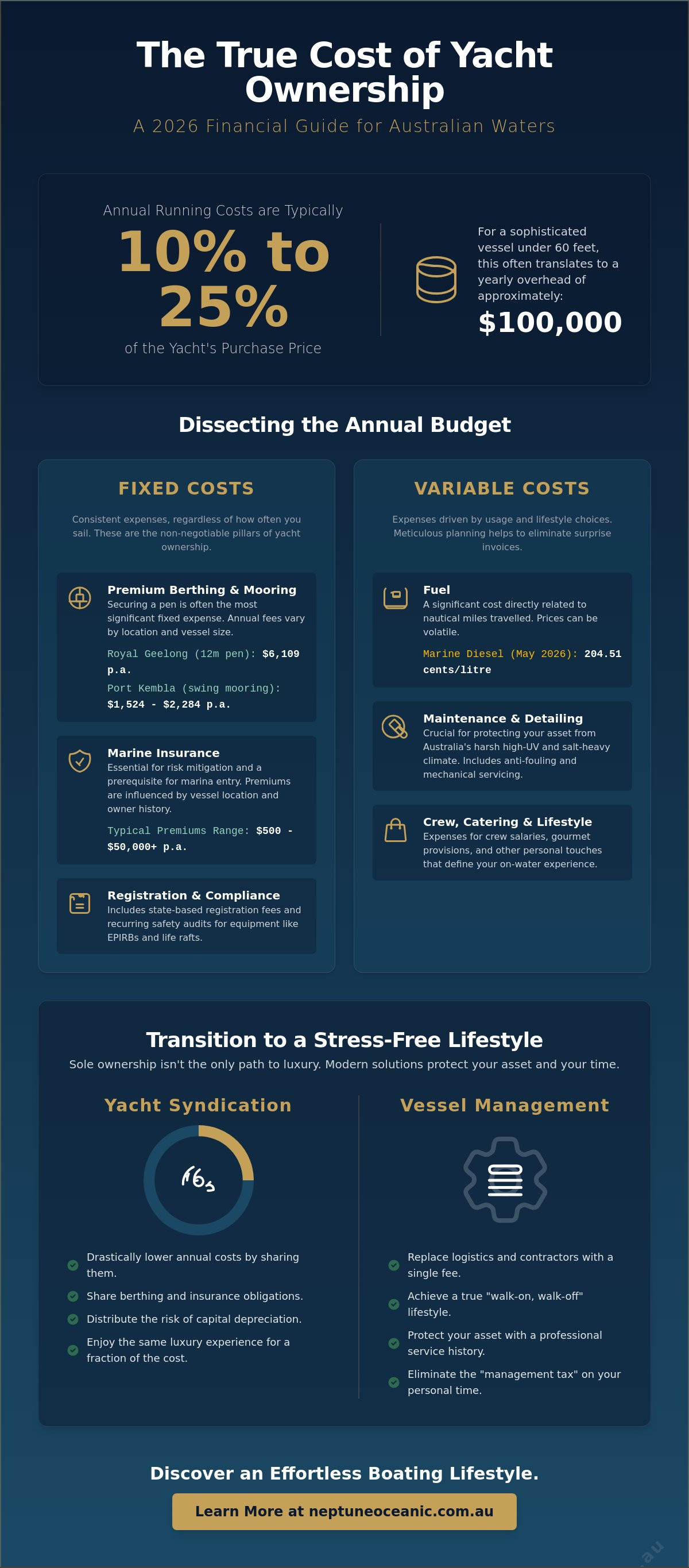
Did you know that the annual cost of owning a yacht in australia typically ranges from 10% to 25% of its initial purchase price? For a sophisticated vessel under 60 feet, that often translates to a yearly overhead of approximately $100,000 just to keep her shipshape and ready for the Whitsundays. It's a significant figure that often catches even the most seasoned mariners off guard when the invoices for berthing, insurance, and anti-fouling start to land.
You likely recognise the frustration of the "management tax" on your personal time. It's the mental load of chasing reliable contractors or navigating the volatile fuel market, where diesel prices hit 204.51 cents per litre in May 2026. Owning a yacht should evoke a sense of freedom and relaxed indulgence, not the stress of administrative burdens and low usage rates relative to high fixed costs.
This comprehensive guide provides a predictable framework for your 2026 maritime budget, from specific NSW mooring fees to the latest registration discounts in South Australia. You'll discover how professional vessel management and syndication can protect your asset while delivering a seamless, walk-on walk-off lifestyle that returns the focus to the water where it belongs.
Key Takeaways
- Master the "10% rule" to accurately budget for your vessel and learn to distinguish between unavoidable fixed costs and variable operational expenses.
- Identify the essential maintenance protocols, from anti-fouling to mechanical servicing, required to maintain luxury standards in Australian waters.
- Compare the financial advantages of syndication, which can drastically lower the annual cost of owning a yacht in australia by sharing berthing and insurance obligations.
- Transition to a stress-free lifestyle with professional vessel management that replaces logistics and contractor coordination with a simple, consolidated monthly fee.
Understanding the Financial Commitment of Yacht Ownership
Owning a premium vessel in Australian waters is an exercise in asset management as much as it is a pursuit of pleasure. For those entering the market, calculating the annual cost of owning a yacht in australia requires a departure from casual hobby budgeting. Industry standards suggest that owners should anticipate spending approximately 10% of the vessel's initial purchase price every year on upkeep. For a superyacht or a high-end cruiser, this figure ensures the vessel remains in peak condition, both mechanically and aesthetically.
The Australian climate presents unique challenges that can accelerate costs if not managed with precision. Our high UV index and salt-heavy coastal air are relentless. Without professional detailing and protective coatings, a yacht's exterior can degrade rapidly, leading to expensive restoration work later. Transitioning from basic maintenance to a structured luxury asset management plan is the most effective way to protect your investment and ensure the vessel is always ready for the harbour at a moment's notice.
Fixed vs Variable Costs: An Overview
A clear budget distinguishes between the predictable expenses of keeping a boat and the fluctuating costs of actually using it. Fixed costs remain constant regardless of how many nautical miles you clock up. These typically include:
- Marine Insurance: Essential for risk mitigation and often a prerequisite for marina entry.
- Registration and Compliance: State-based fees and the recurring cost of safety equipment audits, such as EPIRB and life raft certifications.
- Berthing: The cost of securing a premium pen in sought-after locations like Sydney Harbour or the Gold Coast.
Variable costs are driven by your lifestyle choices. Fuel consumption, gourmet catering, and unscheduled repairs fall into this category. Many owners find that understanding the annual cost of owning a yacht in australia is about more than just the bottom line; it is about eliminating the surprise of hidden costs through meticulous planning.
Capital Depreciation and Market Value
In the Australian secondary market, a vessel's value is tied directly to its pedigree of care. While engine hours are a standard metric for valuation, the aesthetic condition and service history often carry more weight during a survey. Buyers look for a "paper trail" of professional attention. If the financial commitment of sole ownership feels disproportionate to your planned usage, exploring yacht syndication shares can provide the same luxury experience while distributing the depreciation risk across multiple owners.
A vessel backed by a comprehensive professional history commands a "management premium" that significantly offsets the typical depreciation curve seen in neglected boats.
Fixed Annual Costs: Berthing, Insurance, and Compliance
The annual cost of owning a yacht in australia is heavily anchored by three non-negotiable pillars: berthing, insurance, and compliance. Unlike smaller recreational craft, luxury motor yachts over 40 feet require a sophisticated infrastructure to maintain their integrity and legal standing. These fixed costs remain constant regardless of whether you're cruising the Whitsundays or leaving the vessel at rest in her home port.
Premium Berthing and Mooring Logistics
Securing a premium pen is often the most significant fixed expense for Australian owners. While a basic swing mooring in a location like Port Kembla might cost between $1,524 and $2,284 annually for mid-sized vessels, most luxury owners prefer the security of a full-service marina. For 2026, annual berth fees at the Royal Geelong Yacht Club range from $6,109 for a 12-metre pen to $9,643 for catamarans and larger vessels. These costs scale exponentially with the vessel's beam and length, reflecting the premium placed on space in Australia's coastal hubs. A dedicated marina berth provides essential shore power, fresh water, and 24-hour security, ensuring your asset is protected from both the elements and unauthorised access.
Navigating Australian Insurance and Safety Standards
Marine insurance in 2026 is a complex landscape where premiums can range from $500 to $50,000. These figures are a major component of the annual cost of owning a yacht in australia, with factors such as the vessel's location and the owner's claims history playing a critical role. Insurers closely monitor risk in cyclone-prone regions of Northern Queensland, often adjusting premiums based on seasonal storage plans. Implementing a professional vessel maintenance plan can often lead to more favourable terms, as underwriters value the reduced risk associated with expert care. Beyond insurance, owners must manage recurring compliance cycles for safety gear, including EPIRB registration, flare replacements, and mandatory fire system servicing.
Registration fees also vary by state, though some regions offer temporary relief. South Australia is providing a 50% discount on recreational boat registrations between December 2025 and December 2026. Finally, every owner should budget for an annual haul-out. Hardstand storage and travel lift fees are necessary logistics for hull inspections and underwater maintenance. If these fixed burdens feel overwhelming, many owners find that yacht syndication shares offer a more balanced approach. It's a way to enjoy the prestige of a large yacht while sharing the administrative and financial weight with like-minded individuals, ensuring your time on the water remains focused on relaxation.
The Cost of Maintaining Luxury Standards
Maintaining a vessel to a luxury standard requires a disciplined shift from reactive repairs to a consistent, preventative schedule. While smaller boats might get away with occasional check-ups, a 40-foot motor yacht relies on a complex network of mechanical systems that demand expert oversight. The engine, generator, and gearbox are the heart of your experience on the water. Neglecting these doesn't just risk a breakdown; it compromises the safety of everyone on board and significantly inflates the long-term annual cost of owning a yacht in australia.
Beyond the engine room, systems like air conditioning, desalination units, and the electrical grid require constant monitoring. In the Australian heat, a failing AC unit or a blocked desalination filter can quickly turn a weekend getaway into a logistical headache. Professional management ensures these systems are serviced before they fail. This preserves the seamless "walk-on walk-off" experience that defines the luxury lifestyle, allowing you to focus on the horizon rather than the bilge.
Preventative Maintenance and Anti-fouling
The underwater profile of your yacht is under constant assault from aggressive Australian marine growth. An annual haul-out is a critical component of your budget, involving a travel lift to remove the vessel from the water for high-pressure hull scrubbing and fresh anti-fouling paint. Following a structured yacht preventative maintenance schedule is always more cost-effective than dealing with the fuel inefficiency and hull damage caused by neglect. During this time, technicians also replace sacrificial anodes. These small components are your primary defence against electrolysis and galvanic corrosion, which can otherwise destroy expensive running gear and through-hull fittings.
Professional Detailing and Interior Upkeep
Australia’s high UV index and salt-laden air are unforgiving to gelcoats and teak decking. Without regular professional detailing, salt crystals act like sandpaper on polished surfaces, leading to a dull, weathered appearance. A weekly or fortnightly wash-down is the baseline for preventing this degradation and keeping the vessel in showroom condition. Inside the cabin, luxury standards are maintained through meticulous care of timber finishes, fine upholstery, and high-end appliances. This includes sanitation system servicing and bilge management to ensure the interior environment remains fresh and inviting. By investing in consistent professional maintenance and detailing, you ensure your yacht remains an asset of pride rather than a source of administrative stress.
If the logistics of coordinating these various contractors feels like a second job, many owners choose to consolidate these requirements into a single management package. This approach provides a clear, predictable view of the annual cost of owning a yacht in australia while ensuring every technical and aesthetic detail is handled by seasoned professionals.
Syndication vs Sole Ownership: A Financial Comparison
The decision between sole ownership and a managed syndicate often comes down to a simple calculation of value and time. While owning 100% of a vessel offers ultimate autonomy, the annual cost of owning a yacht in australia can feel like a significant "management tax" when usage is limited to a few weeks a year. Syndication rebalances this equation. By sharing the asset with a small group of like-minded owners, you effectively divide the fixed overheads of premium berthing, insurance, and compliance, ensuring the financial commitment is always in proportion to your time on the water.
This model moves the focus from the burden of logistics to the joy of the journey. Instead of paying for a vessel to sit idle in a marina, owners in a syndicate enjoy a higher efficiency of usage. The costs are shared, but the experience remains exclusive, providing a level of luxury that is often more sustainable and rewarding for the modern yachting enthusiast.
Capital Allocation and Depreciation Strategy
Investing in luxury yacht syndication shares allows you to allocate capital more efficiently, often providing access to a larger or higher-spec vessel than you might choose to fund alone. This model significantly lowers your exposure to depreciation while maintaining a tangible stake in a premium asset. When you're ready to transition to a different vessel, the structured nature of a managed syndicate simplifies the resale process, as the boat carries a comprehensive, professional service history. Unlike chartering, which represents a sunk cost with no return, syndication offers an equity advantage that preserves your capital through ownership of a high-value maritime asset.
Operational Savings Through Professional Management
Beyond the initial purchase, the ongoing annual cost of owning a yacht in australia is mitigated through the collective purchasing power of a managed fleet. Professional facilitators often secure better rates for parts, specialised detailing, and mechanical servicing, passing those efficiencies directly to the owners. This structured approach also eliminates the "stress tax" associated with coordinating multiple contractors and logistics. A dedicated manager acts as a steady hand, preventing the costly operational errors that often arise from infrequent usage or neglected systems. It's a methodical way to ensure the vessel is always in showroom condition, ready for a seamless departure whenever you arrive at the marina.
Ready to experience the freedom of the water without the administrative burden? Explore our current yacht syndication shares and discover a more sophisticated way to own.
Achieving an Effortless Boating Lifestyle
The true luxury of yachting isn't found in the teak decks or the engine's horsepower; it's found in the time you spend enjoying them. For many, the hidden "opportunity cost" of personal vessel administration is the most significant expense of all. When you calculate the annual cost of owning a yacht in australia, you must account for the hours spent sourcing reliable contractors, auditing safety gear, and managing the endless stream of invoices. Professional management transforms this burden into a seamless experience, allowing you to reclaim your weekends for the water rather than the wharf.
Consolidating your overheads into a single monthly management fee provides a level of financial clarity that sole owners rarely achieve. Instead of juggling dozens of receipts from various marine trades, you receive a transparent, itemised overview of your vessel's health. This methodical approach is the ultimate form of asset protection. It ensures that every system is maintained to a showroom standard, which is vital for preserving resale value in a discerning market. Beyond the technical, a managed service allows for bespoke preparation. Whether it's ensuring the galley is stocked with your preferred vintage or the air conditioning is set to the perfect temperature before you step on board, the focus remains entirely on your indulgence.
The Role of a Professional Vessel Manager
A professional manager acts as a high-end concierge for your maritime life. They bridge the gap between the complex technical requirements of a modern motor yacht and the effortless lifestyle you expect. This role involves constant operational oversight, ensuring that every voyage begins with a pristine, fully fuelled vessel. From coordinating annual haul-outs to managing unscheduled repairs, a manager handles the friction of ownership behind the scenes. This steady, reliable hand provides the peace of mind that your asset is being cared for by an expert who understands the nuances of the Australian marine environment.
Next Steps: Transitioning to Managed Ownership
If the logistical weight of sole ownership no longer aligns with your lifestyle, it may be time to evaluate more efficient alternatives. Exploring current yacht share opportunities is an excellent way to access premium vessels while significantly reducing your individual administrative load. When assessing a management package, look for transparency in reporting and a clear track record of maintenance excellence. Ask yourself whether your current boating habits justify the full annual cost of owning a yacht in australia on your own, or if a managed syndicate would better serve your desire for freedom and ease. The transition to a "walk-on walk-off" model is often the moment yachting becomes a pleasure again, rather than a second job.
Navigating Your Future on the Water
Navigating the financial landscape of yacht ownership doesn't have to be a complex solo voyage. By accounting for the 10% rule and the specific 2026 Australian berthing rates discussed, you can move from unpredictable expenses to a steady, managed budget. Protecting your asset through professional maintenance and detailing ensures that your vessel remains a source of pride rather than a logistical burden. While the annual cost of owning a yacht in australia is a significant investment, it's one that can be balanced through strategic syndication and expert oversight.
Neptune Oceanic specialises in bridging the gap between your maritime aspirations and the practical realities of vessel care. Our programs are managed by maritime experts who are dedicated to redefining the walk-on walk-off experience through transparent monthly fee structures. Explore our luxury yacht syndication shares and start your effortless boating journey today.
The horizon is waiting. It's time to return your focus to the joy of cruising and leave the administration in our steady, reliable hands.
Frequently Asked Questions
What is the 10% rule for yacht maintenance in Australia?
The 10% rule is a widely accepted industry benchmark suggesting that owners should budget approximately 10% of their vessel’s initial purchase price for annual upkeep. This figure generally covers the essential costs required to maintain a luxury standard, including mechanical servicing, aesthetic detailing, and administrative compliance. For larger or older vessels, this percentage can climb higher as systems require more frequent attention or replacement to ensure reliability in local waters.
How much does it cost to berth a 40ft yacht in a premium Australian marina?
Berthing costs for a 40ft (approx. 12-metre) vessel vary significantly by location and facility type. In 2026, annual fees for a 12-metre pen at the Royal Geelong Yacht Club are set at $6,109, while visiting vessels can expect nightly rates around $45.00. Premium marinas in high-demand hubs like Sydney or the Gold Coast often command higher prices, reflecting the value of secure pens, 24-hour security, and immediate access to shore power and fresh water.
Is yacht insurance more expensive in Australia due to weather risks?
Insurance premiums are highly sensitive to regional risks, particularly in Northern Queensland where the threat of cyclones is a significant factor. While the average annual premium can range from $500 to $50,000, vessels kept in tropical zones during the summer months often face higher costs or specific storage requirements. Most Australian marinas mandate at least third-party liability coverage, though comprehensive policies are the standard for luxury asset protection.
Can I reduce my annual costs by managing the vessel myself?
While handling logistics personally avoids management fees, it often increases the overall annual cost of owning a yacht in australia through missed preventative maintenance and lack of bulk purchasing power. DIY management also places a heavy "management tax" on your personal time, often leading to lower usage rates. Professional managers leverage established relationships with contractors to ensure work is completed correctly the first time, preventing expensive reactive repairs later.
What are the hidden costs of buying a used yacht in Australia?
The most common hidden expenses involve outdated safety compliance gear and deferred mechanical maintenance. New owners often find that EPIRBs, life rafts, and fire suppression systems require immediate, costly recertification or replacement. Additionally, if a previous owner neglected anti-fouling or anode changes, the cost of rectifying hull corrosion or electrolysis damage can be substantial. A thorough pre-purchase survey is essential to uncover these potential financial burdens.
How does yacht syndication reduce the individual's annual financial burden?
Syndication slashes the individual annual cost of owning a yacht in australia by dividing fixed overheads, such as berthing and insurance, across multiple owners. Instead of one person bearing the full weight of a $10,000 marina pen, the cost is shared, making the luxury lifestyle more sustainable. This model aligns your financial commitment with your actual time on the water, ensuring you aren't paying for a vessel to sit idle.
What is included in a typical professional vessel management fee?
A professional management fee typically covers the administrative and technical oversight required to keep a yacht in showroom condition. This includes scheduling mechanical services, coordinating detailing, and ensuring all safety equipment remains compliant with Australian maritime standards. The primary benefit is the "walk-on walk-off" experience, where the vessel is fully prepared, fuelled, and cleaned before you arrive, allowing for a completely frictionless boating experience.
How often does a yacht need to be hauled out for anti-fouling in Australian waters?
Most yachts in Australia require a haul-out every 12 to 18 months to address the aggressive marine growth found in our coastal regions. This process involves a travel lift to remove the vessel for high-pressure cleaning and the application of fresh anti-fouling paint. During this annual window, technicians also inspect the hull and replace sacrificial anodes, which is a critical step in preventing electrolysis from damaging your underwater running gear.
Disclaimer
The content published on this blog reflects the views and experience of Neptune Oceanic and is provided for informational purposes only. While every effort is made to ensure accuracy, we make no representations or warranties regarding the completeness or suitability of any information for your individual circumstances. Nothing in this blog should be construed as financial, legal, or investment advice. All financial figures, cost estimates, and usage statistics are indicative only and may vary depending on vessel, location, and market conditions. Neptune Oceanic is a member of the Boating Industry of Australia (BIA).