
Boat Club vs Syndication: The Ultimate Australian Choice for Luxury Boating in 2026
The average luxury boat owner in Australia uses their vessel fewer than ten times a year. It is a sobering statistic when you consider the hours lost to maintenance and the significant depreciation that comes with sole ownership. You likely want the freedom of a weekend on the harbour without the "hassle tax" of managing a complex asset yourself. Choosing between a boat club vs syndication is the essential first step toward a lifestyle defined by effortless indulgence rather than logistical stress.
We believe that your time on the water should be spent enjoying the view, not scrubbing the deck or worrying about the latest maritime safety regulations. This article will help you discover the critical differences between fleet subscriptions and equity-based ownership to find your perfect match. We'll examine how professional management and syndication shares can provide a genuine walk-on walk-off experience, ensuring you enjoy the pride of a premium vessel with none of the traditional burdens.
Key Takeaways
- Identify whether your priority is temporary fleet variety or the long-term value of owning a tangible asset through a managed syndicate.
- Navigate the financial landscape of a boat club vs syndication by comparing upfront entry fees against the benefits of shared equity.
- Assess your lifestyle needs to determine if you prefer the flexibility of a rental-style subscription or the confidence that comes with vessel familiarity.
- Uncover how professional vessel management packages eliminate maintenance burdens while maintaining the highest standards of luxury and safety.
- Gain a clear checklist for choosing a path that provides a true walk-on walk-off experience on the Australian coast.
Beyond Sole Ownership: Navigating the Boat Club vs Syndication Landscape
For decades, the Australian maritime dream followed a predictable path: you saved, you bought, and you spent your weekends maintaining a vessel that sat idle most of the year. Times have changed. High-net-worth professionals in Sydney, the Gold Coast, and beyond are increasingly rejecting the inefficiency of sole ownership. They want the salt air and the sunset cruises without the "hassle tax" of engine services and antifouling. This shift has created a pivotal crossroad for modern boaters. Deciding between a boat club vs syndication is no longer just a financial choice; it is a lifestyle strategy.
The core dilemma rests on a simple question: do you value variety or equity? Managed maritime services have risen to meet the needs of those who are time-poor but lifestyle-rich. These models ensure that your time on the water is pure indulgence. You no longer have to be the mechanic, the cleaner, or the captain. Instead, you can rely on a steady, professional hand to manage the complexity behind the scenes. Your choice today will dictate your financial outlay and the quality of your time on the water for years to come.
The Shift Toward Fractional Ownership
More Australians are choosing shared models in 2026 because the maths simply makes sense. There is a profound psychological shift happening across the country. Boaters are moving away from "owning a machine" and toward "owning an experience." This is where the fractional ownership model becomes so compelling. It allows you to distribute the costs of a high-end vessel across a small group of like-minded individuals. By securing yacht shares, you access a level of luxury that might be hard to justify alone. Professional management has removed the traditional friction of sharing. Everything is organised for you, from the detailing to the stocking of the galley.
Why Intent Matters: Access vs Asset
Your intent defines your experience. A boat club provides access; it is essentially a high-end subscription service. It suits those who want to try different hulls or who only boat occasionally. However, it often lacks the "pride of ownership" that many desire. Syndication is an asset-based model. You own a piece of the boat. This ownership mindset changes everything. You aren't stepping onto a rental; you are returning to your vessel. The quality of the craft is typically higher in a syndicate, and the familiarity you gain with the boat’s handling and systems builds genuine confidence. It’s the difference between staying in a hotel and owning a holiday home.
Decoding the Models: Access-Based Clubs vs Asset-Based Syndication
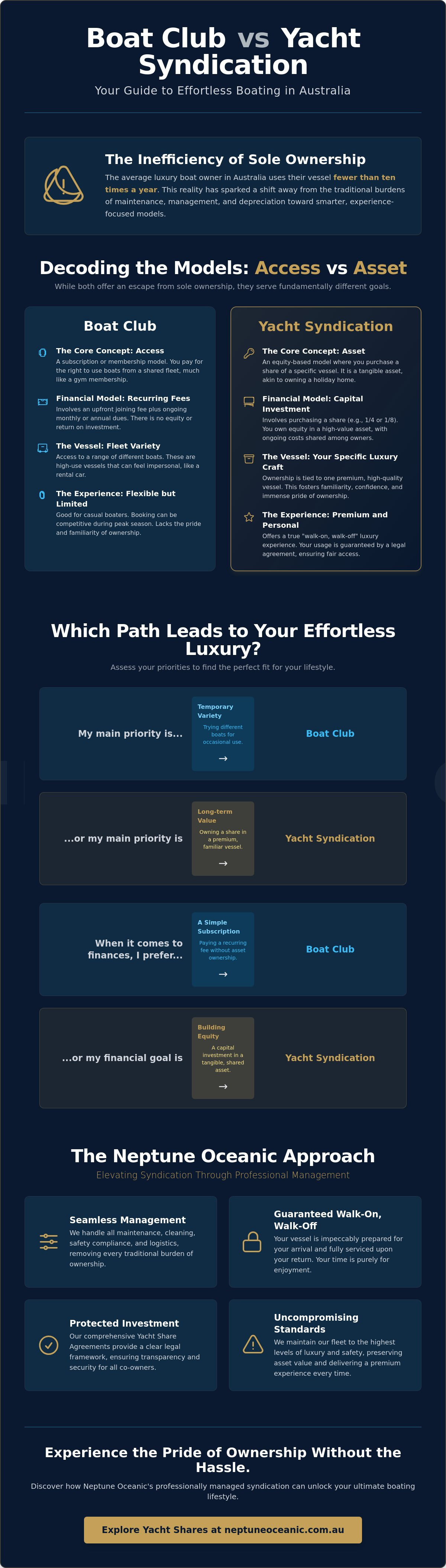
The fundamental divide in the boat club vs syndication debate lies in what you actually hold at the end of the day. One offers a key to a fleet. The other offers a title to a vessel. Understanding these structures is vital before you commit your capital or your leisure time to a particular path. While both models promise an escape from the grind of sole ownership, they serve very different maritime goals.
How Boat Clubs Function
Think of a boat club as a high-end gym membership for the water. You pay a joining fee and ongoing monthly dues for the right to book various boats from a managed fleet. It is an attractive entry point for those who enjoy variety. One weekend you might take out a bowrider for a quick blast. The next, you might choose a small cruiser for a quiet lunch. This flexibility comes with a trade-off. During the peak Australian summer, from the Christmas break through to the end of January, securing a booking can be a challenge. You are competing with every other member for the same prime Saturdays. These vessels are high-use assets. They rarely feel like they belong to you.
The Mechanics of Yacht Syndication
Yacht syndication operates on a more exclusive plane. When you purchase a share, you are acquiring a tangible asset. This is a capital investment in a specific, high-quality vessel. Your rights, responsibilities, and usage are clearly defined in a yacht share agreement. This legal framework ensures your investment is protected and that the rules of engagement with your co-owners are transparent. Having your name on the title changes your perspective. You aren't just a user. You are an owner. This breeds a level of care and familiarity that is impossible to replicate in a club model. You know exactly how the hull handles and that the vessel has been maintained to an exacting standard.
The financial structures are equally distinct. Clubs rely on recurring fees that provide no return on exit. Syndication involves an upfront cost for your equity, with shared ongoing expenses managed professionally. If you decide to move on, you have a physical asset to sell. For those seeking a truly premium experience, exploring yacht syndication shares offers a path to genuine ownership without the solitary burden of maintenance. It is about investing in a lifestyle that rewards you every time you step onto the deck.
The Ultimate Decision Checklist: Comparing Financials, Access, and Experience
Choosing your path to the water involves more than just a preference for a particular hull. It requires a strategic look at how your capital works for you. While both models aim for a frictionless experience, the boat club vs syndication decision often hinges on whether you view boating as a consumable service or a long-term investment. To help you navigate this, we've compiled the definitive checklist for the discerning Australian boater.
- Upfront Commitment: Boat clubs typically require a joining fee and an annual subscription. These are sunk costs. Syndication involves purchasing a percentage of a specific vessel, creating an equity position that can be resold.
- Ongoing Expenditure: Clubs charge flat monthly dues. In contrast, syndication owners share the actual running costs, often articulated through transparent vessel management pricing structures.
- Booking Certainty: Club members use a fleet-wide app where peak dates are often a lottery. Syndication owners typically use a fair, structured calendar that guarantees usage during those coveted summer holidays.
- Vessel Presentation: A club boat is a high-turnover tool used by many. A syndicated yacht is a private asset, kept in showroom condition through dedicated detailing and professional care.
Financial Logic and Asset Protection
The financial argument for shared ownership is compelling. By splitting the capital and the operational burden, syndication distributes yacht ownership costs across a small, exclusive group. This makes luxury attainable without the waste of an under-utilised asset. Professional management is the linchpin here. It ensures that the vessel is maintained to the highest standards, which is essential for preserving its resale value when you eventually decide to move on from your yacht syndication shares. You aren't just paying for access; you're protecting an investment.
The Experience Factor: Luxury vs Utility
There is a distinct difference in how it feels to step on board. Both models offer a walk-on walk-off service, but the depth of that service varies. On a club boat, you're a transient user. You must remove all your gear at the end of the day, and the boat's configuration is standardised for the masses. In a syndicate, the boat is yours. The familiarity you gain with the vessel's nuances builds genuine confidence at the helm. When you're entertaining corporate clients or family, the pride of ownership is palpable. You aren't just showing them a subscription service; you're welcoming them onto your yacht. It's a level of sophistication that a fleet-based model simply can't match.
Evaluating Your Boating Lifestyle: Which Path Leads to Effortless Luxury?
Finding the right fit between a boat club vs syndication depends largely on how you envision your time on the water. Statistics show the average luxury boat owner in Australia uses their vessel fewer than ten times a year. If you fall into this category, the low-commitment nature of a club might seem attractive. However, for those who view the water as a weekly sanctuary, the decision becomes more nuanced. Frequency of use is the primary filter, but it isn't the only one. You must also consider your confidence as a skipper and the level of hospitality you expect for your guests.
Vessel familiarity is often overlooked in the pursuit of variety. Stepping onto a different hull every time you leave the marina can be unsettling. Every boat has its own personality, its own way of responding to a swell, and its own specific dashboard layout. In a syndicate, you master one machine. This mastery translates to safety and poise, especially when docking in a crowded harbour or handling a sudden change in weather. If you typically entertain large groups or corporate clients, the capacity and layout of a high-end yacht offer a level of comfort that a standard club fleet cannot match.
The Case for Syndication
Syndication is designed for the boater who refuses to compromise on quality. One of the primary fractional ownership benefits is the ability to access vessels with superior specifications, from premium sound systems to custom galley fit-outs. You also gain the peace of mind that comes with a vessel maintenance plan. This ensures the boat is always in peak condition, managed by professionals who understand the intricate needs of a luxury asset. It is the ideal scenario for families who want a consistent, high-standard "home away from home" on the water. If you are ready to secure your place on a world-class vessel, we invite you to browse our current yacht syndication shares and find your perfect match.
When a Boat Club Might Suit
A boat club can be an excellent choice for beginners. If you are new to the maritime world, a club allows you to "try before you buy" into a specific model or size. It provides a broad introduction to different styles of boating without a significant capital outlay. Some boaters prioritise variety over consistency, enjoying the ability to swap between a fishing boat and a day cruiser. For many, clubs serve as a valuable stepping stone. They provide the hours on the water needed to build skills before graduating to the more permanent and prestigious world of managed syndication shares.
The Neptune Oceanic Approach: Elevating Syndication Through Professional Management
At Neptune Oceanic, we understand that the choice between a boat club vs syndication isn't just about the vessel; it's about the quality of the moments you spend on it. We've refined a process that bridges the gap between the pride of ownership and the desire for hassle-free yachting. Our philosophy is built on the belief that luxury is defined by the absence of worry. By integrating high-end hospitality with rigorous maritime operational standards, we act as the steady hand that manages complexity behind the scenes. You simply step on board and enjoy the freedom of the open water.
Safety and compliance are the foundations of our service. As of May 2026, we have already updated our fleet to meet the latest Australian maritime standards. For example, we've ensured all lifejackets comply with the AS 4758 standard that became mandatory in Queensland in late 2025. We're also currently updating safety equipment for our Western Australian vessels to meet the September 2026 deadline for handheld flares. Our comprehensive vessel compliance services mean you never have to track shifting regulations yourself. We handle the logistics so that your focus remains on the horizon.
Bespoke Management for Discerning Owners
We provide more than just a place to park a boat. Our premium vessel management packages are designed to keep every yacht in showroom condition. This involves meticulous detailing, regular mechanical inspections, and a proactive approach to maintenance. When you own a share in a Neptune Oceanic syndicate, you have a dedicated maritime team at your disposal. We treat your vessel with the care it deserves, ensuring that every time you arrive at the marina, the boat is pristine, the systems are tested, and the galley is ready for your arrival. It is a concierge-level experience that turns an asset into a sanctuary.
Your Next Steps to the Water
The transition to a managed lifestyle is seamless. We invite you to view our current opportunities across Australia's most iconic waterways. The onboarding process is transparent and methodical, designed to ensure you feel supported from the very first inquiry. We'll guide you through the share agreement, introduce you to your vessel, and provide the training needed to feel confident at the helm. If you've been weighing the merits of a boat club vs syndication, you'll find that our model offers the perfect balance of equity and ease. Ready to elevate your lifestyle? Explore our current Yacht Syndication Shares and discover the true meaning of effortless luxury on the water.
Secure Your Future on the Australian Coast
The choice between a boat club vs syndication ultimately defines the quality of your leisure time. While clubs offer a flexible entry point for variety, managed syndication provides the tangible asset and pride of ownership that many discerning boaters seek. You've seen how professional management bridges the gap between complex logistics and pure indulgence. By choosing equity, you aren't just paying for access; you're investing in a consistent, high-end maritime lifestyle where every detail is handled by experts.
Neptune Oceanic combines national Australian expertise with bespoke high-end hospitality to ensure your time on the water is frictionless. Our professionally managed yacht syndication programs offer a true walk-on walk-off experience, allowing you to focus on the sunset rather than the engine room. It's time to reclaim your weekends and enjoy the freedom you've earned.
Discover Effortless Luxury with Neptune Oceanic Yacht Shares
We look forward to welcoming you on board and helping you navigate your next great adventure.
Frequently Asked Questions
What is the main difference between a boat club and a boat syndicate?
The primary distinction lies in ownership and equity. In a boat club, you pay a subscription fee for the right to book various vessels from a fleet, similar to a gym membership. A boat syndicate involves purchasing a fractional share of a specific yacht, making you a legal co-owner. When comparing a boat club vs syndication, the former is about temporary access while the latter is an investment in a tangible asset.
Do I actually own the boat in a syndication model?
Yes, you hold a legal equity stake in the vessel. Your name is on the title, and you own a proportional share of the yacht alongside a small group of other owners. This ownership is protected by a formal share agreement, ensuring that your capital is tied to a physical asset rather than a service contract. It provides the pride and security of ownership without the total financial burden of a sole purchase.
How many days per year can I use the boat in a syndication?
Usage is typically allocated based on the size of your share, with a one-eighth share generally providing around 43 to 45 days of boating per year. Most syndicates use a fair, structured booking system that allows you to plan for peak periods, such as the Christmas holidays or long weekends. This system ensures equitable access and allows for "standby" days if the boat is not booked by another owner.
Are boat clubs or syndicates more cost-effective in the long run?
Syndication is often the more financially prudent choice for long-term boaters. While boat club fees are sunk costs with no return, a syndicate share represents equity that can be realised when the share is sold. By sharing the actual operational costs of a single, high-quality vessel, owners avoid the high margins often built into fleet-wide subscription models. It's a more efficient way to enjoy premium maritime luxury.
Can I sell my share in a yacht syndicate if my circumstances change?
You can sell your share at any time, providing a clear exit strategy if your lifestyle needs evolve. Most management agreements include provisions for the resale of shares, and the professional manager often assists in finding a new owner. Unlike a club membership, which usually has no resale value, your syndicate share is a tradable asset that reflects the current market value of the vessel.
Do I need a boat licence to participate in these programs?
You generally require a valid recreational marine driver licence to skipper the vessel yourself. Regulations vary by state, so it's essential to hold the correct qualification for your local waters, whether you're in Sydney Harbour or the Gold Coast. Owners must also stay informed about evolving safety rules, such as the 2025 lifejacket standards in Queensland or the 2026 flare requirements in Western Australia, to ensure a safe experience.
What happens if the boat is damaged while another owner is using it?
If damage occurs, the owner who was in command of the vessel at the time is responsible for the insurance excess and any costs not covered by the policy. Every managed syndicate carries comprehensive marine insurance to protect the asset. This structure ensures that your investment is not financially impacted by the actions of other co-owners, maintaining the peace of mind that is central to the shared ownership model.
How is the maintenance of the vessel managed in a Neptune Oceanic syndicate?
Maintenance is managed entirely by our professional maritime team as part of our vessel management packages. We oversee every technical and aesthetic detail, from routine engine servicing and hull cleaning to meticulous detailing before you arrive. This proactive approach ensures the yacht remains in showroom condition and complies with all safety standards. You simply enjoy a walk-on walk-off experience while we handle the logistical complexity behind the scenes.
Disclaimer
The content published on this blog reflects the views and experience of Neptune Oceanic and is provided for informational purposes only. While every effort is made to ensure accuracy, we make no representations or warranties regarding the completeness or suitability of any information for your individual circumstances. Nothing in this blog should be construed as financial, legal, or investment advice. All financial figures, cost estimates, and usage statistics are indicative only and may vary depending on vessel, location, and market conditions. Neptune Oceanic is a member of the Boating Industry of Australia (BIA).