
Yacht Co-ownership Agreement Checklist: DIY vs Managed Syndication in 2026
Would you really leave the keys to your freedom in the hands of a handshake deal and a hope for fair weather? While the dream of shared ownership is to slash costs and double the joy, the reality often hits a reef when owners realise they haven't agreed on who pays for the unexpected engine service or how to fairly organise the peak summer calendar. This is where a robust yacht co-ownership agreement checklist becomes your most essential piece of safety gear. It's the difference between a relaxing afternoon on the harbour and a stressful phone call with a co-owner about a broken winch.
We understand that you're looking for the liberty of the open sea, not a second job as a part-time vessel manager. You want a structure that's legally watertight but doesn't feel like a burden. This guide will help you master the complexities of shared vessel ownership by comparing the DIY approach of private contracts against the effortless ease of professionally managed syndication. We'll show you how to secure a "walk-on, walk-off" experience that handles the maintenance and administrative headaches behind the scenes, leaving you with nothing but the horizon.
Key Takeaways
- Identify the right legal framework for your vessel, comparing the benefits of Tenants in Common against a Proprietary Limited company structure.
- Discover how to create a transparent sinking fund that protects your capital and ensures long-term mechanical reliability.
- Utilise our comprehensive yacht co-ownership agreement checklist to identify the hidden operational gaps that often lead to owner disputes.
- Learn how a professionally managed syndication can preserve your personal relationships by removing the friction of shared administrative duties.
- Master the logistics of a "walk-on, walk-off" experience, ensuring your boat is always ready for your next escape.
Essential Foundations of a Yacht Co-ownership Agreement
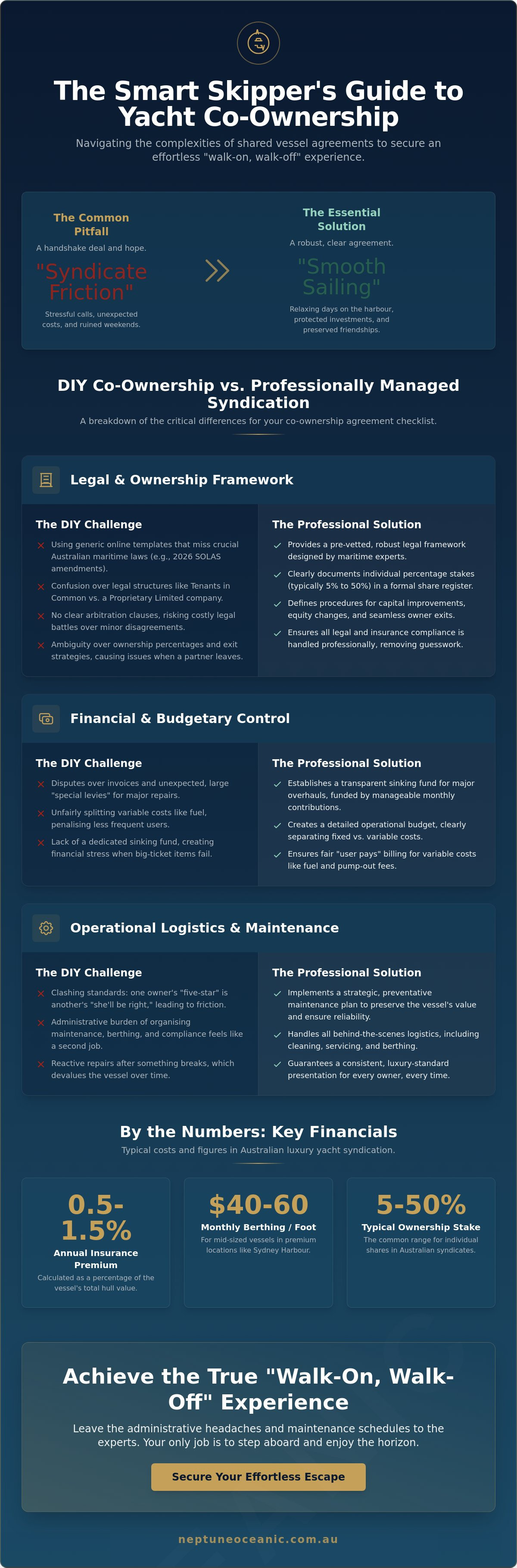
Owning a yacht should be about the salt air and the sun on the deck, not a stack of confusing paperwork. Yet, the foundation of every successful shared vessel is a crystal-clear legal structure. In Australia, most owners choose between a Tenants in Common arrangement or a Proprietary Limited company structure. A Tenants in Common setup allows each owner to hold a direct, registered interest on the vessel's title. Conversely, a company structure sees the entity own the boat, while you own shares in that company. Each path has distinct tax and liability implications that require a professional eye to navigate effectively.
Many people begin their journey with a handshake among friends or family members. This is often where the trouble starts. A formal contract isn't about a lack of trust; it's about preserving the friendship when the unexpected happens. Your yacht co-ownership agreement checklist should start with a written commitment to luxury standards. If one owner expects a five-star presentation and another is happy with a "she'll be right" attitude toward cleanliness, friction is inevitable. Aligning these expectations early ensures the vessel remains a sanctuary for everyone involved, rather than a source of "syndicate friction" that ruins the weekend.
Defining Ownership Shares and Equity
Transparency is the bedrock of a smooth syndicate. Every agreement must clearly document individual percentage stakes, which typically range from 5% to 50% in Australian syndicates. It's equally vital to outline how capital improvements are handled. If the group decides to upgrade the navigation suite or install a new teak deck, the agreement must specify if this increases an owner's equity or is simply a shared maintenance cost. Maintaining a formal share register prevents any ambiguity regarding who owns what, especially if an owner decides to exit the syndicate and sell their portion.
The Legal Framework: Why Templates Aren’t Enough
It's tempting to download a generic template from the internet, but these documents rarely account for the specific nuances of Australian maritime law or the 2026 SOLAS amendments regarding safety gear and lifting appliances. Fractional ownership involves complex layers of liability and insurance requirements that a basic form simply can't cover. Without specific arbitration clauses, a minor disagreement over a berthing fee or a scratched hull could escalate into a costly legal battle. Opting for managed yacht syndication provides a pre-vetted, robust legal framework. It removes the guesswork, ensuring that the heavy lifting of legal compliance is handled by experts so you can focus on the horizon.
Financial and Legal Safeguards: Protecting Your Investment
Financial clarity is the anchor of a successful syndicate. Without a transparent system for managing capital, the joy of ownership quickly dissolves into disputes over invoices and bank statements. Establishing a dedicated sinking fund is a non-negotiable step for any serious owner. This fund acts as a financial buffer, accumulating capital over time to cover major mechanical overhauls, sail replacements, or hull repaints. By contributing to this fund monthly, owners avoid the stress of sudden, large scale "special levies" that can disrupt personal cash flow and strain the partnership.
Your yacht co-ownership agreement checklist must clearly distinguish between fixed and variable costs. Fixed costs, such as insurance premiums and berthing, remain constant regardless of how often the boat leaves the marina. In premium Australian locations like a busy harbour or the Gold Coast, monthly berthing for a mid-sized vessel often ranges from $40 to $60 per foot. Variable costs, primarily fuel and pump-out fees, should be billed based on actual usage. This ensures that the owner who enjoys a quiet weekend at anchor doesn't subsidise the fuel bill of an owner who prefers high speed coastal cruising.
The Operational Budget Checklist
A professional budget leaves nothing to chance. It should itemise annual maritime insurance, which typically costs between 0.5% and 1.5% of the vessel's hull value for luxury yachts. You must also allocate specific funds for vessel maintenance plans that prioritise preventative care over reactive repairs. This proactive approach preserves the vessel's resale value and ensures it remains in peak condition. A robust budget also includes a contingency for the "unforeseen," such as a failed bilge pump or a torn bimini, allowing for immediate rectification without waiting for a committee vote.
Insurance and Liability in Australian Waters
General boat insurance often falls short for shared vessels. You require a policy specifically designed for multiple owners, often with Protection and Indemnity (P&I) liability limits of $10 million to safeguard your personal assets. A well-drafted boat-sharing agreement provides the legal framework to define the difference between "negligent use" and "fair wear and tear." If an owner clips a pylon due to a lapse in judgment, the agreement should dictate that they cover the insurance excess and any costs not met by the policy. For those seeking total peace of mind, exploring professional yacht shares can remove these administrative burdens entirely, as the management company handles the legal and financial heavy lifting on your behalf.
Finally, every agreement needs a graceful exit strategy. Life circumstances change, and an owner may eventually need to sell their stake. Including a "right of first refusal" allows existing owners to purchase the departing share before it's offered on the open market, maintaining the integrity of the group while providing a clear path to liquidity for the seller.
Operational Logistics: Maintenance, Berthing, and Compliance
The logistics of keeping a luxury vessel in showroom condition are often underestimated by first-time owners. While the financial side of a syndicate handles the bills, the operational side ensures there is actually a boat ready to sail. A robust yacht co-ownership agreement checklist must move beyond the ledger to define exactly how the vessel is maintained. Without a professional centre of operations, the burden of scheduling engine hours, antifouling, and teak treatments usually falls on the most "organised" owner. This often leads to resentment and a decline in the vessel's resale value if standards start to slip.
Managing these moving parts requires a methodical approach. In a private arrangement, owners must agree on which contractors are trusted to step aboard. Is the local diesel mechanic sufficient, or does the group insist on authorised brand technicians to maintain the warranty? These decisions impact both your safety and your future exit price. Shared boat ownership is most successful when these logistical hurdles are cleared before the first voyage, ensuring the focus remains on the lifestyle rather than the spanner.
Maintenance Standards and Detailing
There is a vast difference between a quick wash-down and professional detailing. For shared luxury assets, the agreement should define "pristine condition" as the baseline for every handover. This means the interior is staged, the stainless steel is polished, and the decks are scrubbed to a professional standard. Integrating a yacht preventative maintenance checklist into your formal agreement ensures that no owner is left cleaning up after another. It sets a clear expectation that the vessel is a shared sanctuary, not a rental car.
Vessel Compliance and Maritime Safety
Safety on the water is a legal obligation that rests heavily on the shoulders of the "Master" during any given trip. In Australia, the Australian Maritime Safety Authority (AMSA) sets strict standards for safety equipment. Your agreement must mandate regular audits of life jackets, flares, and EPIRBs to ensure everything is in date and functional. Utilising vessel compliance services provides an extra layer of protection, ensuring the boat meets all national standards. This professional oversight guarantees that when you take the helm, you are stepping onto a vessel that is not only beautiful but also fully compliant and safe for your family and guests.
Usage Rights and the Walk-on Walk-off Experience
The true test of a co-ownership arrangement isn't the legal structure; it's how you feel when you step onto the deck for a sunset cruise. For most owners, a 25% share provides between 8 and 12 weeks of use per year. However, without a clear strategy for those weeks, the dream of freedom can quickly turn into a logistical puzzle. Your yacht co-ownership agreement checklist must prioritise a fair usage policy that accounts for the high demand of the Australian summer while protecting the spontaneous joy of a midweek escape.
Beyond the calendar, the "Walk-on Walk-off" philosophy is what separates a luxury experience from a chore. This mindset ensures that when you arrive, the vessel is fuelled, the water tanks are topped up, and the linens are crisp. Managing fuel bunkering is a critical part of this flow. Most syndicates employ a "full-to-full" policy, where the departing owner ensures the tanks are replenished for the next user. In a private DIY setup, this requires a high level of trust and coordination at the local marina fuel wharf. Professionally managed structures often automate this process, removing the need for owners to spend their final hour of holiday time queuing for diesel.
The Booking Calendar: Avoiding Conflict
Fairness is the priority when allocating peak periods. A robust agreement implements a rotating schedule for major holidays like Christmas, New Year's Eve, and Easter. This ensures that every owner eventually enjoys the fireworks on the harbour or a long weekend at Rotto. Spontaneous usage is equally important; clear rules should allow owners to book "last-minute" days if the vessel is unreserved 48 hours before departure. This flexibility is a hallmark of professionally managed boat shares, which use sophisticated software to eliminate double-bookings and manual spreadsheet errors.
The Post-Trip Protocol
High standards of presentation are essential for maintaining the luxury feel of the asset. The agreement must define a strict post-trip protocol, covering everything from the removal of personal rubbish to the flushing of the outboard. While owner-led tidying is the baseline in DIY groups, the "Concierge" difference in managed syndication is profound. Professional detailing teams step in between every booking to reset the vessel to a showroom standard. This ensures that any minor breakages or low consumables are reported and rectified immediately, so the next owner never encounters a surprise. If you are ready to trade administrative friction for pure indulgence, explore our yacht syndication shares to see how we facilitate a seamless handover every time.
DIY Co-ownership vs Professionally Managed Syndication
Choosing between a private arrangement and a managed syndicate is the most consequential decision on any yacht co-ownership agreement checklist. While the DIY approach might seem more cost-effective on a spreadsheet, it rarely accounts for the value of your personal time. Managing a luxury vessel is not a hobby; it's a sophisticated logistical operation. A managed syndicate acts as a professional buffer, ensuring that the "Friendship Factor" remains untarnished by the mundane realities of vessel logistics. When a neutral third party manages the rules, personal relationships stay focused on the joy of the journey rather than the friction of the bills.
Professional management often pays for itself through industry trade rates and preventative expertise. Private owners typically pay retail prices for antifouling, engine servicing, and detailing. Conversely, a professional management firm leverages established relationships with contractors to secure priority service and better pricing. This ensures the vessel is always maintained to a standard that preserves its long-term resale value, protecting your capital investment far better than a "she'll be right" DIY approach ever could.
The Burden of DIY Administration
The administrative grind of DIY ownership involves more than just splitting a fuel bill. It means chasing co-owners for overdue levies, vetting marine electricians in a saturated market, and tracking every engine hour with meticulous accuracy. Often, one owner ends up doing 90% of the work. This "Lead Owner" syndrome is the primary cause of syndicate collapse. When that individual burns out or their personal circumstances change, the vessel quickly falls into disrepair. Without a professional centre of operations, the administrative burden eventually outweighs the pleasure of ownership.
The Managed Advantage: Neptune Oceanic
Neptune Oceanic provides the steady, reliable hand required for a truly hassle-free yachting lifestyle. We handle the entire spectrum of logistics behind the scenes, acting as a high-end concierge for your maritime life. Our team demystifies the complexities of The cost of a yacht share by providing a transparent, all-inclusive structure that eliminates the stress of "special levies." You gain a professional maritime team as your single point of contact, ensuring every detail is polished before you step aboard. If you're ready to master the complexities of shared ownership without the administrative headache, we invite you to discover our current yacht share opportunities and experience the horizon on your own terms.
Secure Your Future on the Water
Transitioning from a dreamer to a vessel owner requires more than just a passion for the sea; it demands a strategy that protects both your capital and your peace of mind. We've explored how a robust legal framework and transparent financial planning prevent the common pitfalls of shared ownership. Whether you're navigating the nuances of Australian maritime law or establishing a fair booking calendar, your yacht co-ownership agreement checklist serves as the essential blueprint for a harmonious syndicate. It's about ensuring the boat remains a sanctuary, not a source of administrative stress.
The choice between DIY management and professional syndication ultimately comes down to how you value your time. Why spend your weekends chasing invoices when you could be enjoying the breeze? Our team provides expert maritime oversight and transparent operational budgets, combined with high-end hospitality and detailing standards that ensure every voyage feels like a first-class experience. Explore our professionally managed Yacht Syndication Shares today and discover how we turn the complexities of ownership into a seamless reality. The horizon is waiting for you.
Frequently Asked Questions
What is the best legal structure for yacht co-ownership in Australia?
Tenants in Common and Proprietary Limited companies are the primary choices for Australian owners. A company structure is often favoured for high-value assets because it provides a clear separation of liability and simplifies the transfer of shares when an owner exits. This should be a top priority on your yacht co-ownership agreement checklist to ensure the investment remains secure and easy to manage.
How do we handle a co-owner who doesn’t pay their maintenance levies?
Your agreement should include a clear default provision to protect the syndicate’s cash flow. If an owner misses a levy payment, their booking privileges are typically suspended immediately to prevent further wear on the vessel. If the debt remains unpaid after a set period, the agreement should allow the remaining owners or the manager to force the sale of that share to recover the outstanding costs.
Can I sell my yacht share to anyone, or do the other owners have to agree?
Most syndicates include a "Right of First Refusal" clause in their contract. This means you must offer your share to existing owners before selling to an outsider on the open market. Even if you find an external buyer, the syndicate often retains the right to vet the new member to ensure they align with the group’s established standards of care and maritime operation.
Is a DIY boat share agreement legally binding in all Australian states?
A DIY contract is legally binding across Australia provided it contains the essential elements of a contract, such as offer, acceptance, and consideration. However, its practical effectiveness depends on how well it addresses specific maritime laws and AMSA safety requirements. Relying on a basic template often leaves gaps that lead to expensive disputes if the agreement is challenged in court.
What happens if the yacht is damaged during another owner’s booking?
The owner using the vessel at the time of the incident is generally responsible for the consequences. They are typically required to pay the insurance excess and any repair costs that fall outside the policy coverage. Having a professional manager facilitates this process by providing an impartial assessment of the damage and coordinating the necessary repairs with authorised contractors.
How much does professional yacht share management typically cost compared to DIY?
While professional management involves a service fee, it frequently delivers better long-term value than a DIY approach. Managers access trade pricing for parts and labour that individual owners simply can't reach. They also implement preventative maintenance schedules that avoid the catastrophic repair bills often seen in neglected DIY vessels, effectively protecting your capital investment.
What is a "sinking fund" and why is it essential for yacht co-owners?
A sinking fund is a capital reserve specifically for major, predictable expenses like engine repowers, new sails, or hull treatments. It's essential because it smooths out the cost of ownership over time. Instead of being hit with a massive, unexpected bill every few years, you contribute a small, manageable amount monthly to ensure the vessel's longevity.
How do we decide on a fair usage schedule for public holidays?
Success lies in a rotating holiday calendar that is agreed upon well in advance. This system ensures that every owner gets their turn for Christmas, New Year’s Eve, or Easter over a multi-year cycle. Using a points-based allocation or a simple annual rotation removes the emotion from the process and ensures every member of the syndicate feels the system is fair.
Disclaimer
The content published on this blog reflects the views and experience of Neptune Oceanic and is provided for informational purposes only. While every effort is made to ensure accuracy, we make no representations or warranties regarding the completeness or suitability of any information for your individual circumstances. Nothing in this blog should be construed as financial, legal, or investment advice. All financial figures, cost estimates, and usage statistics are indicative only and may vary depending on vessel, location, and market conditions. Neptune Oceanic is a member of the Boating Industry of Australia (BIA).