
Yacht Preventative Maintenance Schedule: A Practical 2026 Guide

A tidy calendar can still leave important yacht maintenance overdue. A useful yacht preventative maintenance schedule is more than a list of monthly tasks: it reflects the vessel’s equipment, operating hours, conditions and manufacturer guidance. That distinction matters when a generic checklist doesn’t match how your yacht is used.
Routine care is important, but it isn’t always obvious which checks you can organise yourself and which need a qualified professional. Service records, engine hours and upcoming work can quickly become scattered. A clear, repeatable system makes those details easier to manage.
This guide explains how to build a schedule around equipment, risk, use and manufacturer advice, then keep it current as circumstances change. You’ll learn how to organise records and upcoming tasks, when specialist attention may be appropriate, and how professional vessel oversight can help coordinate recurring maintenance.
Key Takeaways
- Build a yacht preventative maintenance schedule around the systems aboard, their condition and how the vessel is used, rather than relying on a generic calendar.
- Use manuals and service records to identify relevant tasks, then note equipment details and operating-hour readings for a more informed plan.
- Separate pre-use checks from recurring inspections and scheduled servicing. Treat example intervals as planning categories, not universal recommendations.
- Keep one central log of work, findings and next due points. Record defects promptly so they’re easier to follow up.
- Consider professional vessel oversight when coordinating recurring maintenance or specialist attendance becomes difficult. Use manufacturer guidance and qualified technical advice as your reference points.
Why a yacht preventative maintenance schedule protects reliability and value
A planned approach helps you track a vessel’s condition and notice developing issues before they become harder to assess. Preventative maintenance means arranging inspections and care in advance, with the aim of identifying developing issues early. It follows the broader principles of preventive maintenance, which focuses on maintaining asset reliability and reducing the chance of system failures.
A yacht preventative maintenance schedule assigns attention to each system at an appropriate point, rather than relying on memory or waiting for something to stop working. It helps you make considered decisions about reliability, safety and the vessel’s condition. It also shows what has been checked, what needs follow-up and where qualified advice is needed.
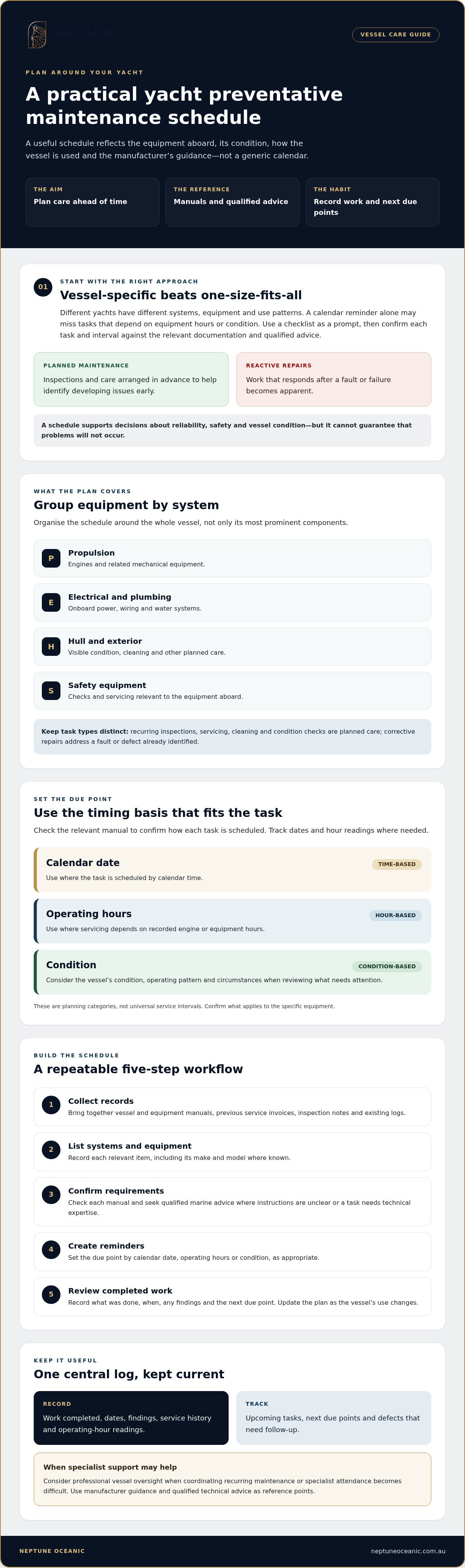
Preventative maintenance plans care ahead of time; reactive repairs respond after a fault or failure becomes apparent. A schedule helps you organise inspections and servicing, but it can’t guarantee that problems won’t occur. No single calendar suits every yacht: design, equipment, operating pattern and manufacturer guidance all shape the right approach.
What belongs in a preventative maintenance schedule?
Group equipment and tasks by system so the plan covers the whole vessel, not just its most prominent components. Categories might include:
- Propulsion: engines and related mechanical equipment.
- Electrical and plumbing: onboard power, wiring and water systems.
- Hull and exterior: visible condition, cleaning and other planned care.
- Safety equipment: checks and servicing relevant to the equipment aboard.
Within each group, distinguish recurring inspections, servicing, cleaning and condition checks from corrective repairs. A repair addresses a fault or defect already identified; planned maintenance is arranged in advance. Use equipment manuals and qualified technical advice to establish which tasks apply and when they’re due. A general list is a prompt, not a substitute for vessel-specific guidance.
Why a generic yacht maintenance calendar can fall short
Two yachts may have different systems, equipment and patterns of use, so a date-based reminder alone may not capture every service point. Some tasks are scheduled by calendar time; others depend on operating hours recorded for an engine or piece of equipment. Check the relevant manual to confirm which basis applies, and track both dates and hour readings where needed.
Conditions and use can also affect what deserves attention, so review the plan periodically. Use a yacht preventative maintenance checklist to prompt task-level considerations, then confirm each item and interval against your own yacht’s documentation and qualified advice. This creates a practical framework: organised enough to guide routine care, but flexible enough to reflect the vessel you own.
How to build a yacht maintenance schedule around the vessel
A dependable plan starts with the yacht you have, not a template designed for another vessel. Build your yacht preventative maintenance schedule from source documents and known service history, then turn each relevant task into a reminder that can be completed and recorded.
Work through these steps:
- Collect records: Bring together vessel and equipment manuals, previous service invoices, inspection notes and existing logs.
- List systems and equipment: Record each relevant item, including its make and model where known.
- Confirm requirements: Check each manual and seek qualified marine advice where instructions are unclear or a task needs technical expertise.
- Create reminders: Set the due point by calendar date, operating hours or condition, as appropriate.
- Review completed work: Record what was done, when, any findings and the next due point. Update the plan as the vessel’s use changes.
A service interval is only useful when it’s checked against the manual for the specific equipment. Similar-looking systems can have different requirements, so don’t transfer an interval from another yacht or rely on a generic schedule without checking its suitability. Apply the same care to safety equipment: consult its documentation and seek qualified advice when specialist inspection or servicing is required.
Start with manuals, service history and operating hours
Gather manuals for the vessel’s systems and equipment alongside service invoices and inspection notes. For each item, record the make, model and available service history. Note engine and generator hours where the manufacturer uses operating-hour intervals; a calendar reminder alone may not show when that work is due.
If a manual, reading or past service detail is missing, mark it as unconfirmed rather than guessing. Ask the equipment manufacturer or a qualified marine professional to help establish the correct information and initial intervals. Keep any advice and supporting service documents with the yacht’s maintenance records.
Turn maintenance needs into a usable calendar
For each task, choose the trigger that matches its guidance: a date, an operating-hour reading or a condition check. Assign a responsible person, then record the completion date, findings and next due point. This creates a clear handover between owners, crew and any specialist involved.
Set reminders early enough to arrange access, parts or specialist attendance, allowing for the practical lead time involved. After the work is completed, update the log promptly and carry forward anything that needs follow-up. This keeps the schedule connected to the yacht’s service history, rather than letting reminders become a static list.
Which yacht maintenance tasks need different intervals?
Not every task belongs on the same kind of reminder. Some checks are part of preparing to use the vessel; others are recurring inspections. Servicing may be due by date, operating hours or professional assessment. The categories below are examples for organising a yacht preventative maintenance schedule, not universal interval recommendations.
| Schedule category | Examples to consider | How to set the timing |
|---|---|---|
| Daily or pre-use checks | Look for obvious changes in bilge areas, visible hoses, electrical connections and safety equipment. | Use the vessel’s procedures and equipment guidance to decide what should be checked before use. |
| Recurring inspections and care | Review visible condition, cleanliness and any developing signs of wear or damage. | Set a suitable review rhythm based on the vessel’s use, condition and qualified advice. |
| Scheduled servicing | Engine or generator servicing, hull work, antifouling and corrosion-related attention. | Follow the equipment manual, operating-hour requirements and professional assessment. |
Routine checks and recurring vessel care
Use checks to notice changes, not to replace technical inspections. A visibly damaged hose, an unexpected change in a bilge area or a loose-looking electrical connection should be recorded and assessed appropriately. Don’t dismantle or repair systems unless you’re qualified to do so. Check and service safety equipment in line with its own instructions.
A useful log makes observations easier to act on. Record what you noticed and when, and note whether it has appeared before. A recurring change may need prompt professional assessment, even if it doesn’t yet appear to affect operation.
Engine, hull and specialist servicing
For engines and generators, follow the manufacturer’s service schedule and record operating hours where the instructions call for hour-based servicing. Don’t rely on a calendar reminder alone if the manual specifies another trigger. Timing for hull condition, antifouling and corrosion-related work depends on inspection findings and the vessel’s circumstances. Sacrificial anodes, for example, need vessel-specific inspection and replacement guidance rather than an assumed universal interval.
Use the relevant equipment manuals and advice from qualified marine professionals to guide technical decisions. They can help interpret requirements for the vessel and its equipment. A general example schedule is best treated as a planning prompt. Maintenance timing depends on equipment requirements and how the vessel is used.
Keeping a yacht maintenance schedule practical and current
A schedule only works if the latest information is easy to find. Keep one central log, digital or paper, as the reference point for tasks, service records and follow-up. This helps avoid repeating completed work unnecessarily and makes outstanding items easier to track.
Give each entry a clear status, such as upcoming, due, completed or awaiting assessment. Use the labels consistently so anyone involved in the yacht’s care can see what needs attention and what has already been done.
What to include in a maintenance log
For each task, record the vessel system, work completed, date, relevant operating-hour or meter reading, findings and next due point. Note who completed the work or is responsible for follow-up. Save service documents with the entry, and include parts used, recommendations made or work that still needs confirmation.
Record defects promptly, even if you’re unsure how serious they are. Describe what you observed and when, without guessing at the cause. Mark the item as awaiting assessment if professional advice is needed, and note the next action, such as arranging an inspection. Raise a recurring observation or warning sign with a qualified professional rather than leaving it until the next routine reminder.
When should the schedule change?
Review the yacht preventative maintenance schedule after servicing, an equipment change, a shift in how the vessel is used, an unusual operating event or new professional advice. Update the record when a manufacturer’s instructions or a qualified professional recommends a different interval. Retain the reason for the change so it’s clear later why the plan was adjusted.
Keep the process simple: check for tasks due, confirm completed work and identify anything awaiting assessment. If the yacht’s condition changes or a warning appears, don’t treat the calendar as permission to defer action. Seek suitable professional assessment and revise the plan once you have reliable guidance.
If coordinating records and recurring vessel care becomes difficult, explore Neptune Oceanic’s vessel management packages as a possible source of professional oversight. Check which scheduling and maintenance activities are included, and continue to use manufacturer instructions and qualified technical advice as the basis for the vessel’s maintenance plan.
When professional yacht maintenance management makes scheduling easier
As a yacht’s systems, service history and upcoming work accumulate, coordination can become a task in itself. Professional management support may help owners organise records, recurring maintenance and specialist attendance. It can be useful when several providers are involved or when the owner wants a clear overview of completed work and what needs attention next.
Management support should complement, not replace, equipment manufacturer instructions or qualified technical advice. A manager can help organise information and communication, while technical decisions and service intervals should remain grounded in the relevant manuals and professional recommendations.
What to ask a vessel manager about maintenance
Before choosing support, clarify how maintenance coordination works in practice. Ask how tasks and service records are tracked, how upcoming work is brought to your attention, and what owner approvals are needed before work proceeds. Also ask how recommendations, urgent findings and follow-up responsibilities are communicated.
- Which administration, logistics and maintenance coordination activities are included in the package?
- Which tasks are handled directly, and which require a separate specialist provider?
- How are completed work, service documents and upcoming tasks recorded and shared?
- How will you be notified about defects, recommendations or work needing your approval?
Clear answers show where management support fits and where you’ll still need a qualified technical provider. Confirm the current scope rather than assuming every maintenance task or specialist service is included.
A calm next step for owners
Compare your current process with the steps in this guide. Can you find the manuals, service history and operating-hour readings easily? Is there one record showing who is following up, what’s due next and what’s awaiting professional assessment? Any gaps can help you decide whether to improve your own system or explore additional coordination.
For broader planning, consider how a strategic vessel maintenance plan could connect individual tasks with the yacht’s overall care. Neptune Oceanic offers vessel management packages covering administration, logistics and operational oversight. Its maintenance and detailing services focus on regular cleaning and mechanical oversight. Confirm which activities are included in a current package before making plans around them.
If a more organised approach would make vessel care easier, consider professional vessel management support with Neptune Oceanic. Start by identifying where coordination is most difficult, then ask how management support could complement your existing records, manufacturer guidance and professional advice.
Make your yacht care plan easier to maintain
A practical yacht preventative maintenance schedule is built around the vessel, not a one-size-fits-all calendar. Use equipment manuals and qualified advice to set relevant intervals, then keep service records, operating-hour readings and upcoming tasks together in one log. Review it when the yacht’s use, equipment or condition changes, and seek professional assessment when something needs attention.
This steady process makes routine care easier to organise and helps owners track work without treating reminders as a substitute for technical guidance. If coordinating vessel care takes more time than you’d like, Neptune Oceanic offers vessel management packages covering administration, logistics and operational oversight. Its maintenance and detailing services focus on regular cleaning and mechanical oversight. Confirm the current package scope before relying on it for particular tasks.
Explore professional vessel management to consider whether added oversight could suit your needs. Start by discussing your coordination needs and confirming how the available support fits alongside your records, manufacturer guidance and professional advice.
Frequently Asked Questions
How often should a yacht be maintained?
There’s no reliable universal maintenance interval for every yacht. Timing depends on the vessel, its equipment, operating hours, condition and manufacturer guidance. Use the relevant manuals and qualified marine advice to set task-specific intervals, rather than applying one frequency across all systems. Review the plan when the yacht’s use or equipment changes, or when inspections and service history provide new information.
What should be included in a yacht preventative maintenance schedule?
A yacht preventative maintenance schedule should cover the vessel’s main systems, including propulsion, electrical equipment, plumbing, hull and safety equipment. For each task, note whether it’s due by calendar date, operating hours or a condition check. Record the completion date, findings and next action so the work remains traceable. Manuals and qualified advice determine the specific tasks and intervals for your yacht, so use general lists as prompts rather than technical instructions.
Can I use a generic yacht maintenance schedule?
A generic schedule can help organise maintenance categories, but it shouldn’t replace your vessel’s manuals or qualified professional advice. Equipment, operating hours, condition and patterns of use all affect what work is appropriate. Treat online examples as prompts, then confirm which tasks and intervals apply to your yacht. Update the plan after servicing, equipment changes or new findings, and record why any recommended interval or task has changed.
How do engine hours affect a yacht maintenance schedule?
Some engine and generator servicing is linked to operating hours, while other checks may be calendar-based or depend on observed condition. Record meter readings and follow the service schedule for the specific equipment. If operating-hour records are missing, or you’re unsure which service point comes next, don’t estimate. Check the manual and ask a qualified marine professional to confirm the appropriate work and interval for that engine or generator.
What is the difference between preventative and reactive yacht maintenance?
Preventative maintenance is planned inspection and care intended to identify wear or service needs before a failure occurs. Reactive maintenance responds after a fault or breakdown appears. Both can form part of vessel care, but a schedule helps you plan routine work and record findings and follow-up. It can’t guarantee that breakdowns will be avoided, so respond appropriately if an inspection reveals a concern or a fault develops.
How can I keep track of yacht maintenance tasks?
Use one central digital or paper log for each task, vessel system, due trigger, completion date, meter reading, findings and next action. Set reminders for upcoming work, keep service documents together and review the log after each service. Make follow-up responsibilities clear, especially when a finding needs professional assessment. For complex coordination, ask a vessel manager what record-keeping and communication support is available, and confirm which activities are included.
When should I ask a marine professional to assess my yacht?
Ask a qualified marine professional when the equipment manual specifies specialist work, you find a defect, a warning appears or the correct task or interval is unclear. Don’t leave a concerning finding until the next scheduled service simply because a reminder isn’t due. Requirements vary by vessel and equipment. If there’s an urgent safety concern, seek prompt assessment from an appropriately qualified professional and follow relevant safety guidance.
Disclaimer
The content published on this blog reflects the views and experience of Neptune Oceanic and is provided for informational purposes only. While every effort is made to ensure accuracy, we make no representations or warranties regarding the completeness or suitability of any information for your individual circumstances. Nothing in this blog should be construed as financial, legal, or investment advice. All financial figures, cost estimates, and usage statistics are indicative only and may vary depending on vessel, location, and market conditions. Neptune Oceanic is a member of the Boating Industry of Australia (BIA).