
Yacht Syndicate Shares: How to Evaluate Managed Co-ownership

What if the value of a yacht share lies not only in the vessel, but also in how clearly you can use and enjoy it? If you're considering a managed yacht syndicate opportunity across Australia, you'll want more than a share on paper. You'll also want to understand how bookings work, how co-owners coordinate and what it takes to keep the yacht ready.
Shared ownership offers a different balance from chartering or owning a yacht outright, but the details matter. A syndicate share may provide an ownership interest and access under agreed programme rules. Chartering is a hire, while sole ownership leaves the full responsibility with one owner. The exact structure and obligations depend on the programme.
This guide explains how yacht syndication works and what to check before committing. You'll learn how to assess the ownership structure, access arrangements, management scope, maintenance responsibilities and ongoing costs, then compare those terms with your boating habits. Professional management can reduce the operational workload, but you should confirm precisely what's included. The aim is to help you decide whether managed co-ownership suits the way you want to spend time on the water.
Key Takeaways
- Check what the share legally represents, and how ownership differs from hiring a yacht or joining a boating club.
- Compare the access calendar and booking rules with how often you plan to go boating and how much flexibility you need.
- For any yacht syndicate opportunity, verify management inclusions, ongoing costs and exit terms in the current programme documents.
- Ask how maintenance, vessel administration and operational oversight are handled instead of assuming every programme offers the same support.
- Use a clear checklist to weigh managed co-ownership against your boating plans before you commit.
What does a yacht syndicate share actually give you?
A yacht syndicate brings multiple participants together to share a vessel under a programme’s ownership, access and cost arrangements. Your share may represent an ownership interest, a contractual right to participate, or another structure set out in the agreement. It doesn’t automatically mean a fixed number of days, a guaranteed resale value or unrestricted use. Broadly, it follows the Fractional ownership model, where parties share an interest in a high-value asset. Start by asking what your share legally represents, then check the access and responsibilities that come with it.
This differs from sole ownership, where one owner holds the vessel and carries the associated responsibilities, subject to any arrangements they make. It also differs from a club membership, which may provide boating access without giving you an ownership interest in a particular yacht. The label “share” alone doesn’t settle the distinction. The programme documents do.
What is the difference between a yacht share and a charter?
A charter is generally a booking to use a yacht for an agreed period. A syndicate share may involve ownership rights as well as access, but the nature of those rights depends on the legal and financial structure. One programme might allocate use through a calendar; another may set different booking rules or responsibilities.
Before comparing the two, read the agreement. Confirm whether you’re acquiring an interest in the vessel or participating under programme terms, how ongoing costs are allocated, and whether transfers or resale are addressed. Don’t assume every syndicate offers the same equity, usage rights or exit options.
What does professionally managed ownership mean?
Professional management can place tasks such as administration, logistics and operational oversight with a management team, reducing the day-to-day work for owners. The scope varies, so check which vessel management, maintenance and detailing services are included, what may incur additional costs, and what remains each owner’s responsibility.
Management doesn’t define your ownership rights or remove the need to understand owner decision-making. The agreement should explain who makes operational decisions, how owners are kept informed and which matters require their input. A clearly described management role helps set expectations and can make shared boating more straightforward.
Neptune Oceanic provides professionally managed yacht syndication shares alongside vessel management services. Its services include vessel administration, logistics, operational oversight, maintenance and detailing. Confirm the precise scope for the programme you’re considering. You can review Neptune Oceanic yacht shares as an example, then check the relevant documents for current share structure, access rules and inclusions.
How does a yacht syndicate organise ownership, access and management?
A syndicate’s day-to-day arrangements involve several connected parts: the legal ownership or participation structure, the process for booking time aboard, how running costs and operations are organised, and the management services provided. The documents should explain how these parts work together. Don’t rely on a share percentage or brochure to fill in practical details.
The programme documents should set out the share structure, access calendar, cost allocation, operating arrangements, management scope, owner responsibilities and decision-making process. Share sizes and annual access figures are specific to each programme, not universal standards. Compare the written terms for the particular opportunity rather than assuming another syndicate’s calendar or arrangements will apply.
How is time aboard allocated between co-owners?
Programmes may use a shared calendar, a rotating allocation, advance booking or a combination of methods. A rotation can balance access across owners over time, while a booking system may let owners request available dates under the programme rules. Neither approach is universal, and peak-period arrangements may differ from those at quieter times.
Check when booking opens, how priority dates are allocated, how much notice is required and whether a confirmed booking can be changed or transferred. These details matter if your family can travel only during school holidays or your plans depend on set leave dates. A flexible calendar may suit spontaneous trips; if your travel dates are fixed, find out how competing requests are resolved.
Which responsibilities can a yacht manager take on?
A manager may coordinate vessel administration, logistics and operational oversight, so owners don’t have to handle every routine task themselves. Maintenance and detailing may also be part of the arrangement. Confirm their scope, frequency and how additional work is handled in the programme documents.
Distinguish routine coordination from decisions that require owner input. Ask how issues are reported, who approves work or expenditure, how owners receive updates and which matters are referred to co-owners. The shared ownership models discussed by Yachting World offer broader context, but your agreement determines the actual process.
To see how a managed share opportunity is presented, review Neptune Oceanic yacht shares, then verify the current access rules, management inclusions and responsibilities against the relevant documents.
How can you compare yacht syndicate opportunities with confidence?
Compare the terms, not just the share price or the yacht’s presentation. A side-by-side review should show what each programme grants, what it expects from you and what happens if your plans change. Ask for current programme documents and check that each figure and inclusion still applies. If an answer is unclear, seek clarification rather than treating it as automatic proof that the programme is unsuitable.
| What to compare | What to verify |
|---|---|
| Share rights | What the share represents, what rights it provides and which owner obligations come with it. |
| Access | How dates are allocated, how peak periods work, and whether booking and change rules suit your plans. |
| Management | Which administration, logistics, operational oversight, maintenance and detailing services are included, and what falls outside the scope. |
| Costs | How recurring costs, additional or exceptional expenses, and financial reporting are described. Compare equivalent items across programmes. |
| Exit terms | How transfers, resale, withdrawal and any end-of-term arrangements are handled under the agreement. |
Which ownership and financial terms should you check?
Start with the agreement’s definition of your share. Then check how ongoing expenses are allocated, how unexpected costs are approved, and what records or updates owners receive. Read the transfer and exit provisions carefully, including any conditions that could affect your ability to leave. If a detail isn’t clear, ask for a written explanation and compare it with the documents before deciding.
Does syndication suit your boating habits better than chartering?
Your likely use matters as much as the programme structure. If you expect to plan recurring trips and value participating in shared ownership, syndication may be worth comparing with occasional charter bookings. A charter can suit changing needs or infrequent use; sole ownership may appeal if you want greater control and are prepared to take on the responsibilities. Neither option is right for everyone. Weigh access certainty, flexibility, continuity and the obligations you’re comfortable carrying. For another perspective on shared boating options, see Boat Club vs Syndication: The Ultimate Australian Choice for Luxury Boating in 2026.
Make a like-for-like comparison: use the same assumptions about access, included management and costs, then check each against current documents. That gives you a clearer basis for deciding which arrangement fits your boating plans.
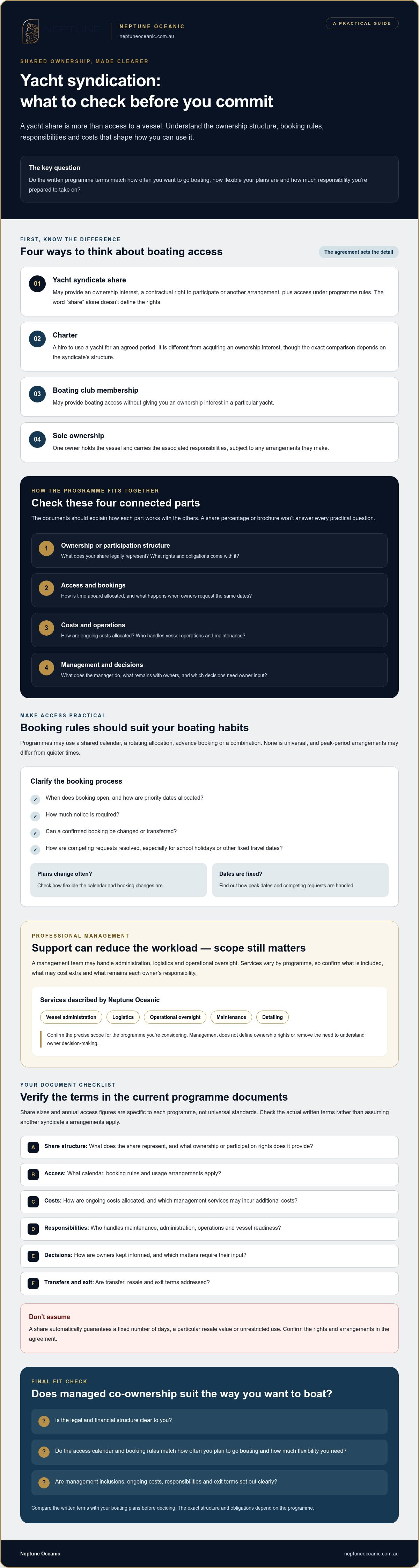
What should you clarify before joining a yacht syndicate?
Make the decision in stages. First, picture how you’d actually use the yacht: how often you hope to go, which periods suit you, how much notice you can give and who you’d usually bring aboard. Then compare the programme terms with those needs, ask about anything unclear and read the current documents before committing. Practical fit depends on more than the destination. Booking rules, owner responsibilities and shared decisions all shape the experience.
What questions should you ask before committing?
Ask for clear answers in writing, then check that they match the agreement. In particular, clarify:
- Access: How are dates booked and allocated, especially during popular periods? What notice applies, and how can a booking be changed?
- Management: Which administration, logistics and operational oversight are included? Are maintenance and detailing covered, and what remains the owners’ responsibility?
- Costs: How are ongoing expenses and unexpected costs allocated, approved and reported?
- Co-owner arrangements: How are disagreements handled, and how are owner decisions made?
- Transfer and exit: What process applies if you want to transfer your interest, sell your share or leave the programme?
Unclear wording isn’t automatically a reason to walk away, but it is a reason to pause and seek an explanation. For a closer look at the paperwork, read Understanding the Yacht Share Agreement: A Guide to Secure Co-ownership. Consider independent legal or financial advice where appropriate, particularly if you’re unsure what rights or obligations the agreement creates.
How do you know whether the arrangement fits your lifestyle?
Test the booking process against your real calendar, not an ideal one. If your trips depend on school holidays, fixed leave or travelling with particular guests, check whether the allocation rules suit those dates and group needs. Consider whether you’re comfortable planning ahead and sharing decisions with other owners. A well-managed programme can reduce operational work, but it doesn’t remove the need to understand shared responsibilities.
Think about what “ready to enjoy” means to you, and confirm which preparation and vessel-care tasks are included rather than assuming they’re covered. Walk-On Walk-Off Boating: The Ultimate Guide to Effortless Luxury in Australia offers related context on ownership expectations. Before deciding, compare your priorities with the current programme terms, then explore Neptune Oceanic yacht shares as one professionally managed option.
How can Neptune Oceanic make managed yacht ownership more straightforward?
Shared boating can feel more straightforward when the operational work is clearly organised. Neptune Oceanic provides professionally managed yacht syndication shares, supported by vessel administration, logistics and operational oversight. It also provides maintenance and detailing services. The exact scope depends on the programme, so confirm what’s included before making a decision.
Professional management can reduce owners’ operational workload, but it doesn’t replace the need for clear ownership terms. Your agreement should spell out what your share means, how access is arranged, which costs and decisions involve owners, and how transfers or exits work.
What does Neptune Oceanic bring to a syndicate experience?
Administration and logistics help coordinate the practical side of shared vessel ownership, while operational oversight and vessel care support an organised approach to managing the yacht. The key is knowing who handles which tasks and where owner input is required. Ask how updates are shared, how maintenance needs are addressed and which services are included in the specific programme.
For an overview of the offering, visit Neptune Oceanic yacht shares. Use the information as a starting point, then verify current share structures, access rules, vessel details and management inclusions against the relevant programme documents.
What is a sensible next step if you are considering a share?
Before making contact, note how often you hope to go boating, which dates matter most, how much notice you can give and who you’d like to bring aboard. Add your questions about booking, ongoing costs, owner responsibilities and exit arrangements. This list will help you assess whether the programme’s terms match your plans.
Then ask for current opportunity details and the documents explaining the share, access and management arrangements. Take time to review them, and seek independent professional advice if you need help understanding the legal or financial terms. Confirm the details and consider whether the structure suits you before deciding.
Explore professionally managed yacht share opportunities
Choose shared ownership with clarity
A yacht syndicate can offer a rewarding way to enjoy time on the water when the share and its practical terms suit your plans. Before deciding, check what ownership rights you receive, how access is allocated, what costs and responsibilities apply, and how you can transfer or exit. These details matter whether you’re comparing shared ownership with chartering or sole ownership.
Professional management can ease the operational workload, but its scope should be clear. Neptune Oceanic provides professionally managed yacht syndication programmes, with vessel administration, logistics and operational oversight, alongside maintenance and detailing services. Confirm which services are included in the specific programme and review its current terms before committing.
If the model fits your boating habits, take the next step at your own pace. Explore professionally managed yacht share opportunities and review the relevant programme information. With clear expectations and careful preparation, shared ownership can bring more confidence to your time on the water.
Frequently Asked Questions
What is a yacht syndicate?
A yacht syndicate is an arrangement in which multiple participants share a yacht under defined programme terms. Depending on the structure, participants may hold ownership interests, access rights or both. Check what the share represents and what rights it gives you. The agreement should explain how use is allocated, which costs apply and how responsibilities are managed. Don’t assume another programme’s structure applies.
Is a yacht syndicate the same as a yacht charter?
No. A yacht charter is generally a booking to use a vessel for an agreed period, while a syndicate may involve an ongoing ownership or participation arrangement. The distinction depends on the programme’s legal and financial documents, not just its marketing language. Check whether the share gives you an ownership interest, what access it provides, how costs are handled and which responsibilities continue beyond each boating trip.
How does booking time work in a yacht syndicate?
Booking arrangements vary between syndicates. A programme might allocate dates through a shared calendar, rotation or another booking process, so don’t assume a particular system applies. Before joining, ask how popular periods are allocated, when bookings open, what notice is required and whether confirmed dates can be changed. Clarify how competing requests or disagreements are managed, and ask for the process in writing so you can compare it with your travel plans.
What costs should I check before joining a yacht syndicate?
Ask for a current written breakdown of the share commitment and ongoing or occasional expenses. Check which management, maintenance and detailing services are included, how additional work or unexpected expenses are approved, and how costs are reported to owners. Also clarify whether transfers or exits involve costs. Figures and cost structures differ between programmes, so don’t rely on another provider’s pricing or assume a listed amount covers every obligation.
Can a yacht syndicate be professionally managed?
Yes. Some syndicates use a professional manager for administration, logistics and operational oversight, which can help organise shared ownership. The scope varies, so confirm how maintenance is arranged, whether detailing is included, how owners receive updates and which decisions remain theirs. Professional management may reduce the operational workload, but it doesn’t replace the need to understand the agreement or the responsibilities attached to your share.
What should I look for in a yacht share agreement?
Check what the share represents, how access is allocated and how costs and responsibilities are handled. Read the rules for owner decisions, dispute resolution, transfers and exits, and confirm how changes to arrangements are communicated. If any wording is unclear, request a written explanation before committing. Agreements differ, so examples from another syndicate aren’t a substitute for reviewing the documents that govern the opportunity you’re considering.
Is a yacht syndicate better than owning a yacht outright?
It depends on your boating habits and how much control and responsibility you want. Syndication involves sharing participation with other owners and may include professional management, while sole ownership gives one owner a different level of control and responsibility. Consider how often you expect to use the yacht, whether shared decisions suit you and how much operational work you’re prepared to manage. Compare the actual terms rather than assuming one option is best for everyone.
Disclaimer
The content published on this blog reflects the views and experience of Neptune Oceanic and is provided for informational purposes only. While every effort is made to ensure accuracy, we make no representations or warranties regarding the completeness or suitability of any information for your individual circumstances. Nothing in this blog should be construed as financial, legal, or investment advice. All financial figures, cost estimates, and usage statistics are indicative only and may vary depending on vessel, location, and market conditions. Neptune Oceanic is a member of the Boating Industry of Australia (BIA).